Bevvy
Created a user-focused app concept to make courier trip recording and editing simpler and more efficient.
Date
2023
Role
UX Design & Research
Client
🔒
Situation
Volkswagen issued a UX Design Challenge focused on the daily reality of couriers: recording and managing their trips. Existing workflows for trip logging were error-prone and cumbersome — couriers often had to deal with incomplete data, manual workarounds, and limited options to correct mistakes after the fact. For someone like a courier who is constantly on the move, every extra tap or confusing screen is a real problem.
The challenge was to design an app concept that makes trip recording and editing simple, reliable, and efficient — built around how couriers actually work, not how a system expects them to.
Situation
Volkswagen issued a UX Design Challenge focused on the daily reality of couriers: recording and managing their trips. Existing workflows for trip logging were error-prone and cumbersome — couriers often had to deal with incomplete data, manual workarounds, and limited options to correct mistakes after the fact. For someone like a courier who is constantly on the move, every extra tap or confusing screen is a real problem.
The challenge was to design an app concept that makes trip recording and editing simple, reliable, and efficient — built around how couriers actually work, not how a system expects them to.
Situation
Volkswagen issued a UX Design Challenge focused on the daily reality of couriers: recording and managing their trips. Existing workflows for trip logging were error-prone and cumbersome — couriers often had to deal with incomplete data, manual workarounds, and limited options to correct mistakes after the fact. For someone like a courier who is constantly on the move, every extra tap or confusing screen is a real problem.
The challenge was to design an app concept that makes trip recording and editing simple, reliable, and efficient — built around how couriers actually work, not how a system expects them to.
Task
As the sole UX designer on this challenge, I owned the entire process end to end:
Research & problem framing: Understanding courier workflows, identifying pain points, and defining what "simple and efficient" actually means in this context.
Persona & journey mapping: Creating a representative user profile and mapping the full trip lifecycle — from starting a recording to reviewing and correcting it later.
UI concept & screen design: Designing the key screens that solve the core problems, grounded in the research findings.
Success metrics: Defining how the effectiveness of the design could be measured.
Task
As the sole UX designer on this challenge, I owned the entire process end to end:
Research & problem framing: Understanding courier workflows, identifying pain points, and defining what "simple and efficient" actually means in this context.
Persona & journey mapping: Creating a representative user profile and mapping the full trip lifecycle — from starting a recording to reviewing and correcting it later.
UI concept & screen design: Designing the key screens that solve the core problems, grounded in the research findings.
Success metrics: Defining how the effectiveness of the design could be measured.
Task
As the sole UX designer on this challenge, I owned the entire process end to end:
Research & problem framing: Understanding courier workflows, identifying pain points, and defining what "simple and efficient" actually means in this context.
Persona & journey mapping: Creating a representative user profile and mapping the full trip lifecycle — from starting a recording to reviewing and correcting it later.
UI concept & screen design: Designing the key screens that solve the core problems, grounded in the research findings.
Success metrics: Defining how the effectiveness of the design could be measured.
Action
Starting with the user, not the interface I began by building the persona "Max Zuckerberg" — a courier whose daily routine exposed the typical friction points: forgotten trip starts, unreliable automatic tracking, and no easy way to fix errors after the fact. From there, I developed problem statements and a user journey map that made the pain points concrete and prioritizable.
Focusing the solution on two critical moments Rather than designing an entire app, I identified the two moments that matter most in a courier's workflow and concentrated my effort there:
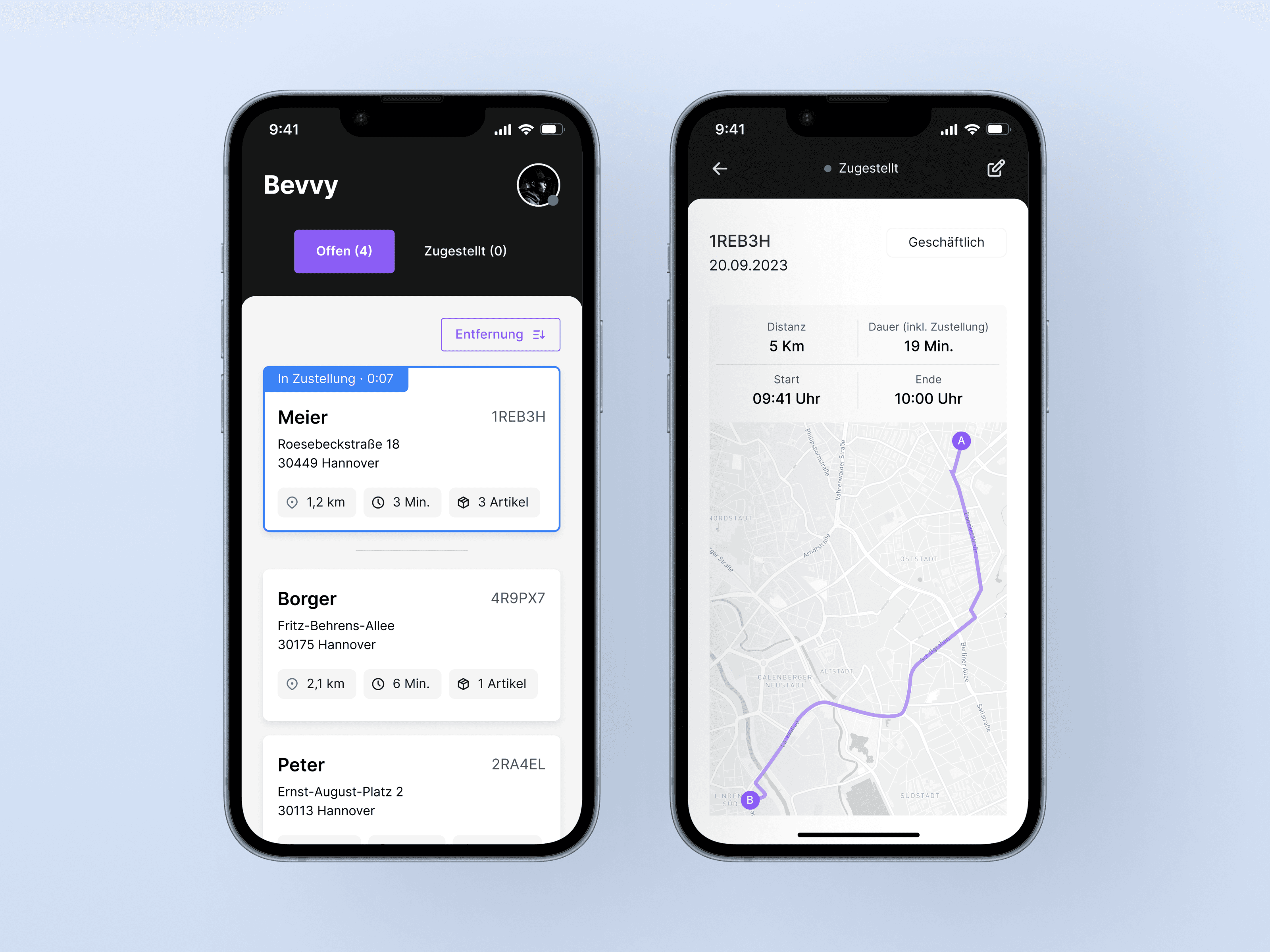
Trip Recording — a clean, distraction-free interface for starting, pausing, and stopping recordings. The design combines automatic data capture with the option for manual entries, so couriers stay in control without being burdened by unnecessary steps.
Trip Editing & Review — a screen where couriers can quickly scan their recorded trips, spot issues, and make corrections or add missing information. The emphasis was on clarity and speed — a courier reviewing trips at the end of a long day needs to find and fix problems in seconds, not minutes.
Defining measurable success To move beyond subjective assessment, I defined evaluation metrics tied to real usability outcomes: user error rates during recording and editing, journey completion time, and overall satisfaction. These metrics provided a framework to validate whether the design actually solves the problems it set out to address.
Action
Starting with the user, not the interface I began by building the persona "Max Zuckerberg" — a courier whose daily routine exposed the typical friction points: forgotten trip starts, unreliable automatic tracking, and no easy way to fix errors after the fact. From there, I developed problem statements and a user journey map that made the pain points concrete and prioritizable.
Focusing the solution on two critical moments Rather than designing an entire app, I identified the two moments that matter most in a courier's workflow and concentrated my effort there:
Trip Recording — a clean, distraction-free interface for starting, pausing, and stopping recordings. The design combines automatic data capture with the option for manual entries, so couriers stay in control without being burdened by unnecessary steps.
Trip Editing & Review — a screen where couriers can quickly scan their recorded trips, spot issues, and make corrections or add missing information. The emphasis was on clarity and speed — a courier reviewing trips at the end of a long day needs to find and fix problems in seconds, not minutes.
Defining measurable success To move beyond subjective assessment, I defined evaluation metrics tied to real usability outcomes: user error rates during recording and editing, journey completion time, and overall satisfaction. These metrics provided a framework to validate whether the design actually solves the problems it set out to address.
Action
Starting with the user, not the interface I began by building the persona "Max Zuckerberg" — a courier whose daily routine exposed the typical friction points: forgotten trip starts, unreliable automatic tracking, and no easy way to fix errors after the fact. From there, I developed problem statements and a user journey map that made the pain points concrete and prioritizable.
Focusing the solution on two critical moments Rather than designing an entire app, I identified the two moments that matter most in a courier's workflow and concentrated my effort there:
Trip Recording — a clean, distraction-free interface for starting, pausing, and stopping recordings. The design combines automatic data capture with the option for manual entries, so couriers stay in control without being burdened by unnecessary steps.
Trip Editing & Review — a screen where couriers can quickly scan their recorded trips, spot issues, and make corrections or add missing information. The emphasis was on clarity and speed — a courier reviewing trips at the end of a long day needs to find and fix problems in seconds, not minutes.
Defining measurable success To move beyond subjective assessment, I defined evaluation metrics tied to real usability outcomes: user error rates during recording and editing, journey completion time, and overall satisfaction. These metrics provided a framework to validate whether the design actually solves the problems it set out to address.
Result
The outcome was a focused, research-grounded app concept that directly addresses the core frustrations of courier trip management:
A clear design rationale — every screen and interaction decision traces back to a documented user need, not assumption.
Two high-impact screens that solve the most critical moments in the courier workflow: recording trips reliably and correcting them effortlessly.
A measurable framework for evaluating design effectiveness through error rates, task completion time, and user satisfaction.
A compelling presentation (Bevvy App – UI/UX Design Task) that communicates the process, decisions, and outcomes in a structured narrative.
The project demonstrated my ability to take an ambiguous brief, ground it in user research, and deliver a focused, well-reasoned design solution within the constraints of a time-limited challenge.
Result
The outcome was a focused, research-grounded app concept that directly addresses the core frustrations of courier trip management:
A clear design rationale — every screen and interaction decision traces back to a documented user need, not assumption.
Two high-impact screens that solve the most critical moments in the courier workflow: recording trips reliably and correcting them effortlessly.
A measurable framework for evaluating design effectiveness through error rates, task completion time, and user satisfaction.
A compelling presentation (Bevvy App – UI/UX Design Task) that communicates the process, decisions, and outcomes in a structured narrative.
The project demonstrated my ability to take an ambiguous brief, ground it in user research, and deliver a focused, well-reasoned design solution within the constraints of a time-limited challenge.
Result
The outcome was a focused, research-grounded app concept that directly addresses the core frustrations of courier trip management:
A clear design rationale — every screen and interaction decision traces back to a documented user need, not assumption.
Two high-impact screens that solve the most critical moments in the courier workflow: recording trips reliably and correcting them effortlessly.
A measurable framework for evaluating design effectiveness through error rates, task completion time, and user satisfaction.
A compelling presentation (Bevvy App – UI/UX Design Task) that communicates the process, decisions, and outcomes in a structured narrative.
The project demonstrated my ability to take an ambiguous brief, ground it in user research, and deliver a focused, well-reasoned design solution within the constraints of a time-limited challenge.
